|
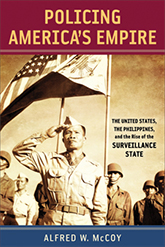
Policing America’s Empire
The United States, the Philippines, and the Rise of the Surveillance State
Alfred W. McCoy
Alfred W. McCoy, R. Anderson Sutton, Thongchai Winichakul, and Kenneth M. George, Series Editors
“In this stunning book, McCoy reveals how empire shapes the intertwined destinies of all involved in its creation. Written with deft strokes, this is an instant classic of historical writing.”
—Lloyd Gardner, author of
The Long Road to Baghdad: A History of U.S. Foreign Policy from the 1970s to the Present
2011 Winner of the George McT. Kahin Prize, the Association for Asian Studies
At the dawn of the twentieth century, the U.S. Army swiftly occupied Manila and then plunged into a decade-long pacification campaign with striking parallels to today’s war in Iraq. Armed with cutting-edge technology from America’s first information revolution, the U.S. colonial regime created the most modern police and intelligence units anywhere under the American flag. In Policing America’s Empire Alfred W. McCoy shows how this imperial panopticon slowly crushed the
Filipino revolutionary movement with a lethal mix of firepower,
surveillance, and incriminating information. Even after Washington freed its colony and won global power in 1945, it would intervene in the Philippines periodically for the next half-century—using the
country as a laboratory for counterinsurgency and rearming local
security forces for repression. In trying to create a democracy in the Philippines, the United States unleashed profoundly undemocratic forces that persist to the present day.
But security techniques bred in the tropical hothouse of colonial rule were not contained, McCoy shows, at this remote periphery of American power. Migrating homeward through both personnel and policies, these innovations helped shape a new federal security apparatus during World War I. Once established under the pressures of wartime mobilization, this distinctively American system of public-
private surveillance persisted in various forms for the next fifty years,
as an omnipresent, sub rosa matrix that honeycombed U.S. society with active informers, secretive civilian organizations, and government counterintelligence agencies. In each succeeding global crisis, this covert nexus expanded its domestic operations, producing new contraventions of civil liberties—from the harassment of labor activists and ethnic communities during World War I, to the mass incarceration of Japanese Americans during World War II, all the way to the secret blacklisting of suspected communists during the Cold War.
“This remarkable study provides a meticulous analysis of the novel colonial system developed by the U.S. in the Philippines after the murderous conquest, with startling implications for the shape of the modern world. As McCoy demonstrates, the U.S. occupation developed a major innovation in imperial practice, relying on the ‘information revolution’ of the day to establish intense surveillance and control of the occupied population, along with violence when needed and privileges to obedient elites. This ‘protracted social experiment in the use of police as an instrument of state power’ left a devastating legacy for the Philippines, while also contributing substantially to the modes of suppression of independence and social change elsewhere, and returning home to lay the foundations for a national security and surveillance state.”
—Noam Chomsky, MIT
“With a breathtaking sweep of archival research, McCoy shows how repressive techniques developed in the colonial Philippines migrated back to the United States for use against people of color, aliens, and really any heterodox challenge to American power. This book proves Mark Twain’s adage that you cannot have an empire abroad and a republic at home.”
—Bruce Cumings, University of Chicago
Alfred W. McCoy is J.R.W. Smail Professor of History at the University of Wisconsin–Madison. His books include The Politics of Heroin and
A Question of Torture.
Media & bookseller inquiries regarding review copies, events, and interviews can be directed to the publicity department at publicity@uwpress.wisc.edu or (608) 263-0734. (If you want to examine a book for possible course use, please see our Course Books page. If you want to examine a book for possible rights licensing, please see Rights & Permissions.)
Of Related Interest:
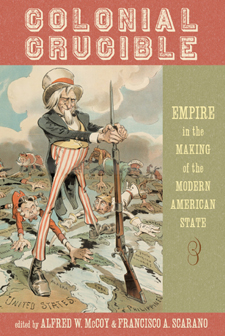 Colonial Crucible Colonial Crucible
Empire in the Making of the Modern American State
Edited by Alfred W. McCoy
and Francisco A. Scarano
“The superb essays in this volume admirably provide a broad approach to understanding the centuries-long growth of American power.”
—Walter LaFeber, author of The New Empire: An Interpretation of American Expansion, 1860–1898
|
|
|
October 2009
LC: 2009010253 DS
672 pp. 6 x 9
47 b/w photos, 7 illus.
Copublished with Ateneo de Manila University Press. Customers in the Philippines should order from Ateneo De Manila University Press at www.ateneopress.org
“McCoy’s remarkable book . . . does justice both to its author’s deep knowledge of Philippine history as well as to his rare expertise in unmasking the seamy undersides of state power.”
—POLAR: Political and Legal Anthropology Review, May 2011
“This forceful book lays the Philippine body politic on the examination table to reveal the disease that lies within — crime, clandestine policing, and political scandal. But McCoy also draws a clear line from Manila to Baghdad.”
—Sheila S. Coronel, Columbia University Graduate School of Journalism
“A stunning, exemplary, and hair-raising fusion of colonial and metropolitan histories. McCoy shows how the Philippines served as a laboratory subject for experiments in policing, intelligence, and ‘black-operations’ that were then repatriated to shape the American domestic surveillance state from World War I forward. This is history at its most powerful and most subversive of imperial self-hypnosis.”
—James C. Scott, Yale University
|



